Insight
Your own website can clearly say who you are. Independent sources play a different role: they can corroborate what you claim from outside your own domain.
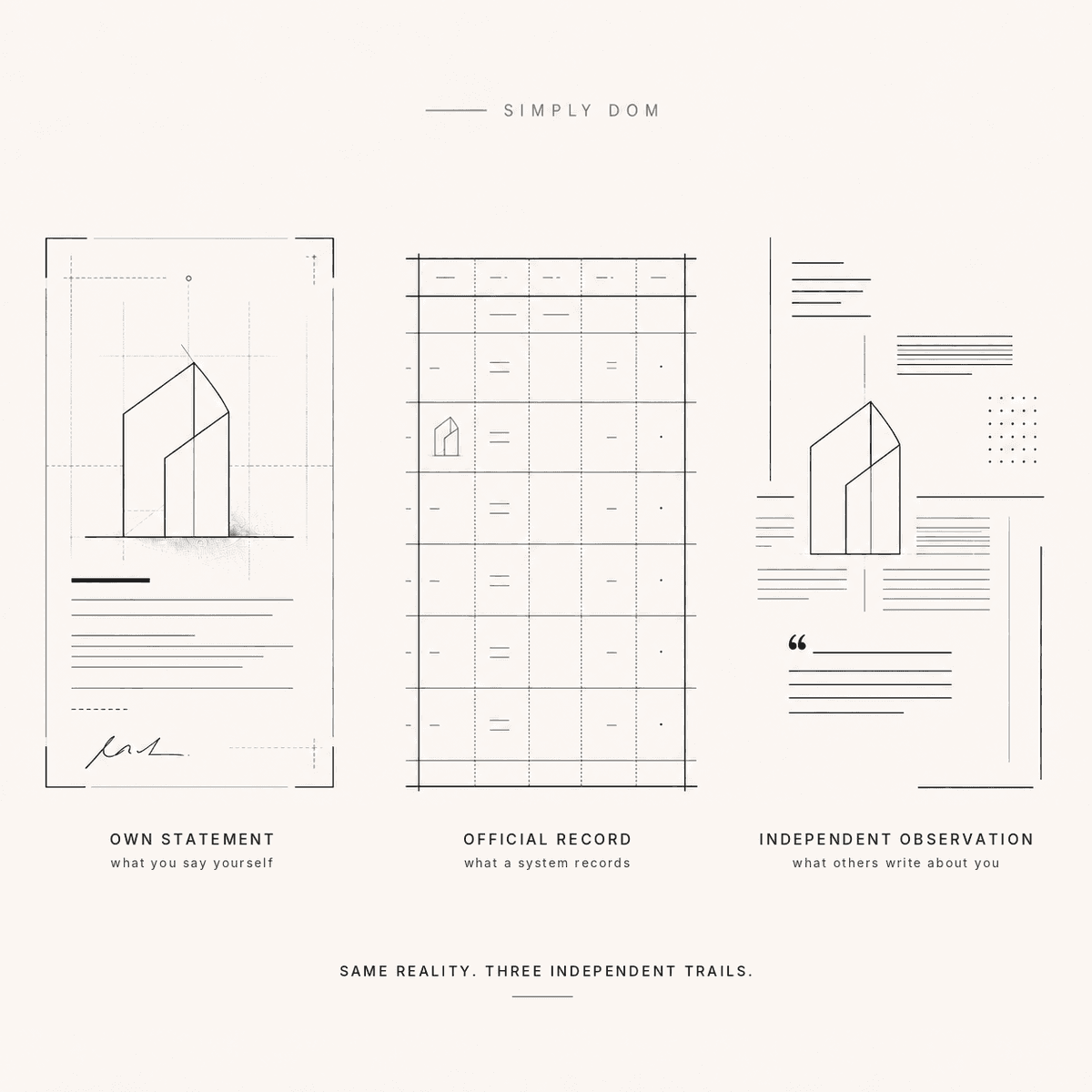
You can have your website perfectly in order.
Clearly explain what you do, for whom and what you're good at. Document cases. Show expertise. Make sure, technically, that search engines and AI systems understand which page belongs to which language, which information is canonical and how everything connects.
That work still matters.
But there is a limit to what your own website can prove. Because there, you are the source.
You can carefully define what you want to be known for. You can explain how you work and show the experience behind it. What your own domain cannot do is confirm that others know, assess or describe you in the same way.
That's the difference between a statement and a witness account.
A statement can be completely accurate. It is still yours.
Cited, mentioned, recommended, visited
That distinction matters more now that information is no longer found only through traditional search results.
AI systems assemble answers from different sources. Sometimes your own website is among them. Sometimes an external page about you. Sometimes your name is mentioned without a link. Sometimes your website appears among the sources while your brand name does not appear anywhere in the answer. And sometimes you are recommended without anyone visiting your site afterwards.
Those are five different events. Today, they are often bundled together under one label: AI visibility.
Or worse: people only look at traffic from ChatGPT, Perplexity or other AI systems because it shows up neatly in analytics.
Low AI referral traffic does not mean you are barely visible. The reverse is true too: a high visibility score from a monitoring tool does not prove that real users see, remember or consider you. Such a score is based on a fixed set of questions at a particular moment, on particular platforms, in a particular language. Useful. Not audience reach.
Semrush made the first distinction concrete. In an analysis of almost four thousand domain appearances in AI answers, more than six in ten included a source link while the brand itself was not mentioned. Citation and brand visibility can therefore diverge even within the same answer.
Ahrefs shows the second part: genuinely measurable traffic from AI systems is still only a fraction of traditional search traffic. And even that number is incomplete, because not every platform passes along the origin of a visit.
Anyone dismissing one metric simply to sell another is making the same mistake as someone who looks only at clicks.
What you publish yourself remains the foundation
None of this means your own website becomes less important. Quite the opposite.
It is the one place where you decide how your story is told. Who are we? What do we do? For whom? How do we work? Which cases support that? What exactly do we mean when we claim a certain expertise?
If that layer is sloppy or contradictory, the rest of the web will form that picture for you. You simply lose control over it.
That is why we have invested a lot of effort at Simply Dom in precisely that layer over the past period: positioning, Insights, Work, multilingual consistency, technical findability and coherence between the different pieces.
But the stronger that foundation becomes, the sharper another question becomes.
What if almost everything proving your expertise has been published by you?
Then you may have an excellent self-description. And very few witnesses.
The rest of the web says something about you too
Muck Rack analysed more than 25 million links shown as sources by ChatGPT, Claude and Gemini. They classified most of them as earned: not published by the brand itself and not paid for.
That does not mean AI “likes PR”. Journalism was only part of that category, and their questions were mainly open questions in which no brand was named beforehand. With that kind of question, it makes sense that third parties carry more weight than in a query where your name is already present.
But it does confirm something: in discovery, problem and comparison questions, sources outside the company website play a role.
Ahrefs found in a study of 75,000 brands that mentions of a brand across the web correlated more strongly with visibility in Google AI Overviews than traditional backlink metrics. Correlated. Did not cause. And for ChatGPT, that same relationship was considerably weaker.
We still know far too little to turn this into a recipe. But one idea is increasingly difficult to ignore:
what credibly exists about you elsewhere becomes part of the information picture surrounding your organisation.
A client describing concretely what you did for them. A partner correctly naming your role. A trade publication using your expertise. A podcast in which you are questioned on substance. Research of yours that someone else builds on.
Those are not magical AI signals. They are pieces of information that no longer come from you alone.
And that gives content a bigger role than “making posts”
This may be the most interesting part for me.
Content is still too often treated as distribution work. Write an article, publish a post, measure reach. Engagement. Clicks. Leads.
That is only one function.
Good content work also shapes the meaning an organisation consistently puts into the world. Not by repeating the same slogan a hundred times. By documenting real work, decisions, observations and results clearly enough for others to do something with them. A client can retell it. A journalist can take something from it. A partner can refer to it. An expert can challenge it. And an AI system may later encounter different parts of it in different places.
There is an operational task here that is still underestimated. Not: produce as much as possible. But: continuously guard the picture of an organisation you help shape through what you make, say, show and document. And at the same time provide enough substance for others to respond independently.
You cannot force that second part. Good content does not guarantee an external mention. A substantive post does not cause a citation. Paid distribution buys reach, but it does not make your own claim independent.
What does exist is indirect evidence that a broader, meaningful presence of a brand across the web correlates with how that brand appears in certain search and AI systems.
For me, that does not make content less important. It makes the assignment bigger.
An example from 2020
During COVID, sports competitions stopped. Archery was no exception.
From ICE Nation, I came up with a simple alternative: if people could not come to one competition, we would bring the competition to them. On 5 April 2020, the first 60x Isolation Shoot took place. At home or at the club, remotely.
After a few stages, it went a step further. Together with the Ianseo team, who at that point likewise had no competitions to process, participants gained the ability to score live through the official scoring app on their smartphone. That changed everything: a remote competition with real, shared scores visible while the competition was taking place. Three start times every Sunday, so participants across different time zones could join.
I kept that going for five years. Every Sunday.
Why is that in this article?
Not because this article is about archery. But because it shows exactly what external confirmation is. And what it is not.
Today, I say that I was the first to use Ianseo's official scoring app for remote competitions, and that remote scored competitions thereby became a reality worldwide. I am certain of that. But that is my statement. It is on my website. It comes from me.
What others confirm is different. In June 2020, at Stage 14, World Archery described the ICE Isolation Shoots and named me as the organiser. Ianseo recorded the competitions, sessions, participants and results, and was still doing so in July 2025 at Stage 277, with participants from different parts of the world.
Those sources do not tell the story I would write today about how I work. They existed before this positioning existed. And precisely for that reason they carry more weight than what I say about it myself.
That is this entire article in one case: real work → your own communication → external observation → evidence that remains without you.
Content can therefore be a starting point
That does not mean we should now turn every good project into “external evidence”. Then we would simply be manufacturing proof again.
But nor should we pretend that content ends the moment we press Publish.
Strong original work creates material others can do something with. An idea that gets discussed. A position that gets challenged. An approach a publication finds interesting enough to document. Sometimes none of that happens. Sometimes it does.
The working hypothesis I find more interesting than “more content = more visibility” is this:
the better you translate real expertise into content that is understandable, useful and shareable, the more opportunities you create for part of it to gain meaning outside your own channels too.
Not automatically. But possibly. And once it does, the web starts helping shape the picture of your organisation.
Four things we no longer put in one bucket
That is why Simply Dom is not looking for one new AI score either.
We look at at least four things separately:
traditional search visibility, now alongside the separate impressions reported for Google's generative search features;
visibility within a fixed set of relevant AI questions, per platform and language: are we mentioned, cited or included as a relevant option?
actual traffic from AI systems to the site;
and: where do credible sources outside our own channels exist that confirm something relevant about Simply Dom?
Not to make that fourth list as long as possible. Quality, context and relevance matter. Volume does not.
And above all: a citation is not a recommendation. A recommendation is not a click. A click is not yet a client.
Not saying more. Becoming easier to substantiate.
Over the past period, we mainly worked on what Simply Dom says about itself. That does not stop.
But it makes less and less sense to follow that by simply creating even more pages where Simply Dom explains what Simply Dom stands for.
The more interesting next step is to examine which parts of that story can also build a credible trail outside our own domain. Sometimes through content. Sometimes through the work itself. Usually through both.
Not as a backlink campaign. Not as a PR trick. Not because a new acronym such as GEO or LLMO says we should. But because the same principle is obvious to a person: you can explain who you are yourself. If someone else can confirm it from their own context, that carries more weight.
So perhaps “How do we become more findable in AI?” is not even the best first question.
I would put two questions before it.
Is it clear what we ourselves are claiming?
And then:
Where outside our own website is there credible evidence that supports it?
Your website can say who you are.
It just does not have to remain your only witness.