Insight
Campaigns hit their reach, the reporting adds up, and still not much happened. That cost shows up later: more media, more variants, eventually a discount. Why I use organic first as a quality gate, and why that is not an argument against paid media.
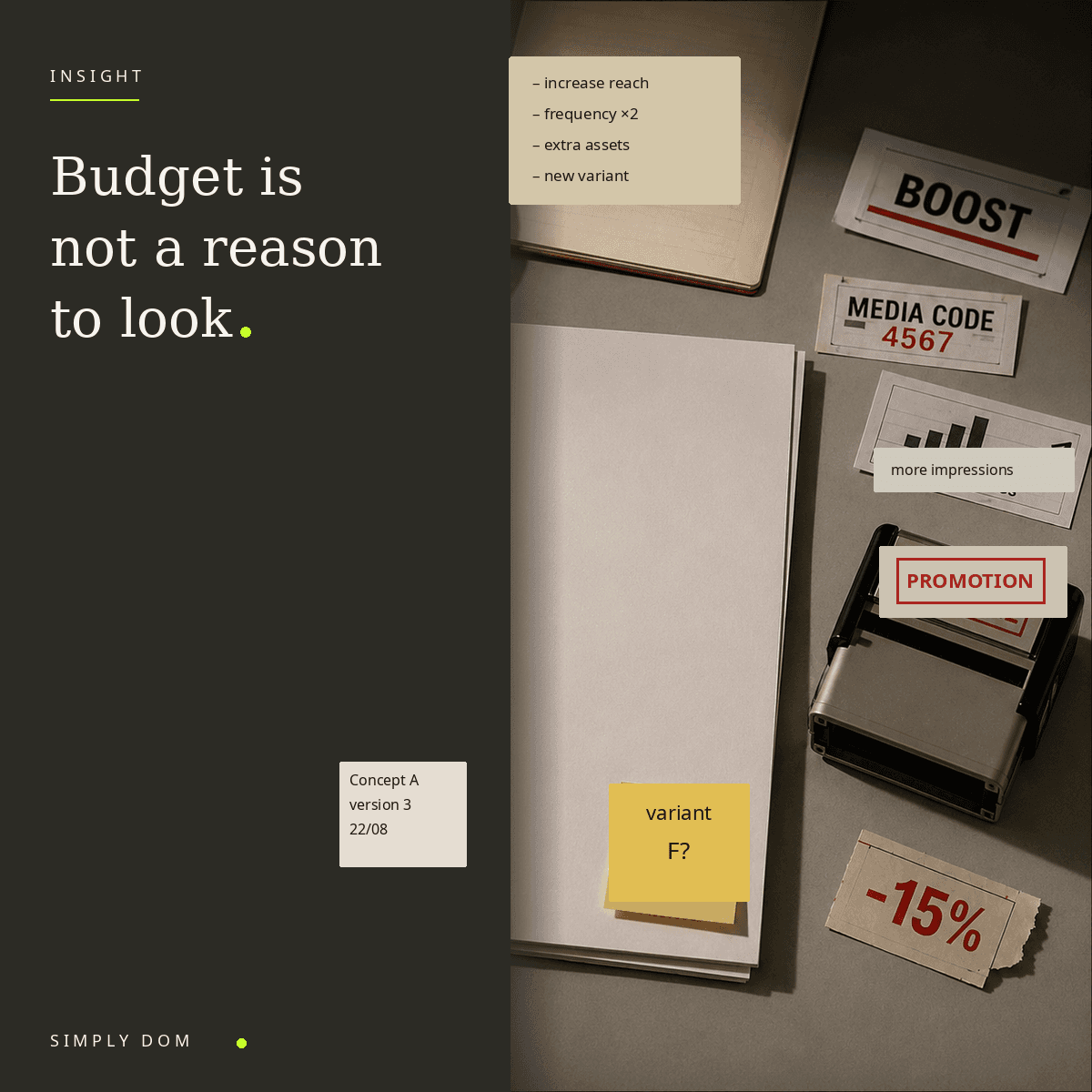
Organic first, for me, is not an anti-paid principle. It is a question I ask beforehand: does this work have enough reason of its own to be looked at, remembered or shared? If the answer is unclear, I find it strange to already put media budget behind it.
Campaigns rarely fail on paper. They get delivered on time, within budget, the assets are there, the targeting is well set and the reporting fills up neatly with reach, impressions, clicks and video views. And yet, in effect, nothing may have happened. Nobody got curious, nobody remembered anything, nobody changed their mind or did anything they weren’t doing before.
That is a difficult kind of failure, because it makes little noise. There is no crisis, no angry customer, no meeting where someone has to explain what went wrong. It’s just that... not much happened. And meanwhile the numbers can still look quite decent.
That is why I’m careful about lumping reach and impact together too quickly. Reach says that something appeared in front of someone, not that this person paid attention to it. Attention doesn’t yet mean someone remembers it, and memory isn’t behaviour yet. That sounds obvious. Even so, we build a fair amount of marketing reporting as if those steps were more or less the same, and we mostly measure the first one.
Safe work has a strange property
Its cost rarely becomes visible right away. Noticeable work can cause discussion; maybe someone has an opinion about it, maybe someone internally has to explain why a particular choice was made. You see that risk immediately. Unremarkable work doesn’t have that problem. It passes.
And if it doesn’t do enough, we simply buy more of the same: more media, more frequency, another asset, another variant, some extra targeting. And eventually a discount, when it turns out people don’t spontaneously choose us. At that point paid media is no longer an amplifier but life support.
That cost doesn’t show up anywhere as a single line item. It’s spread across three lines that are rarely looked at together: the media budget that has to go up a bit every quarter, the production cost of variants that only exist because the previous ones left no impression, and the margin that leaks away into promotions that have to compensate for the weakness of the message. Each of those lines looks defensible on its own. Together they are the price of work that, upfront, didn’t give enough reason to be looked at. I find that a more interesting cost question than what a single campaign cost.
That’s why I like working organic first
Not because organic reach is free. Good content costs time, knowledge, production and above all choices. And not because paid would be bad; I use it myself. But I want to see first what the content does when it has to make do without media budget.
Does anyone look at it? Do people stick around? Are there reactions that show someone genuinely understood it, or questions you only ask if you’ve read it? Does it get forwarded? Do we see that certain topics or formats consistently mean more to the target group than others?
It doesn’t need to go viral. For a specialised B2B company, twenty reactions from the right people are often more informative than a hundred thousand impressions. Popularity isn’t the test. The test is whether there’s a signal somewhere that the content is relevant to someone.
Organic isn’t a perfect test
You shouldn’t be naive about that. Distribution differs per platform. A small account gets less reach than a big one. Some topics are important but intrinsically not very shareable: a specification comparison, a pricing question, a page someone only searches for at the moment they want to buy. And algorithms are not a neutral jury on the quality of your work.
So “it didn’t work organically, so the content is bad” is just as simplistic as “we got a lot of reach, so the campaign worked”. On a small account you’re sometimes testing the algorithm rather than the content. Then a small, cheap paid test aimed at a sharply defined audience is a fairer gate than waiting for organic reach that structurally never comes. That’s not a breach of the principle; it’s the same principle with a different instrument. The question stays the same: is there evidence of relevance before we scale up?
Organic first is therefore not mathematical proof. It is an early reality check. You see where attention arises on its own, where people drop off, and where the content apparently contains enough value for someone to do something with it. What you don’t see is whether someone still remembers it in three weeks, let alone whether they buy differently. For that you need other measurements, and above all time. So the gate doesn’t filter everything out. It does filter out the work that already stumbles on the first step, and that is precisely the work that media afterwards has to compensate for the most.
Paid is supposed to amplify something
If a product video organically answers questions clearly, paid can help get it in front of many more relevant people. If a substantive piece sparks discussion with the right audience, distribution can widen that reach. If a format systematically works, you can scale it up. You’re then buying more distribution for something you already have signals deserves attention, instead of attention for work where you don’t know that yet.
There are exceptions. A launch, a new category, a brand without any organic base: there, paid legitimately builds the first reach. But even then I’d rather test the content small first than roll it out big right away.
What that looks like in practice
In a project I’m working on right now, we use that logic deliberately. We start from what people actually want to know: products, usage, differences between variants, questions that come back in the shop or at customer service. From that we make concrete content, with the expertise that’s already there internally. We watch for a number of weeks what happens with it organically, per topic and per format, and only then decide what deserves to be amplified. Some things that seemed important internally turn out to interest nobody. Other, less spectacular pieces get questions. That’s useful information, and it costs less than a media plan built on an assumption.
It isn’t particularly spectacular. It is rational, though.
The question comes before the media budget
I think that’s often turned around. We ask how many people we can reach with this budget, while I’d rather first know whether we’ve made something worth reaching. Paid media remains useful, sometimes essential. But if nobody gets anything from the message before you pay to show it, I would look at the message first.
Organic first isn’t a cost-cutting strategy. It’s a way to let paid media do what it’s good at: amplifying what is already worth it.